

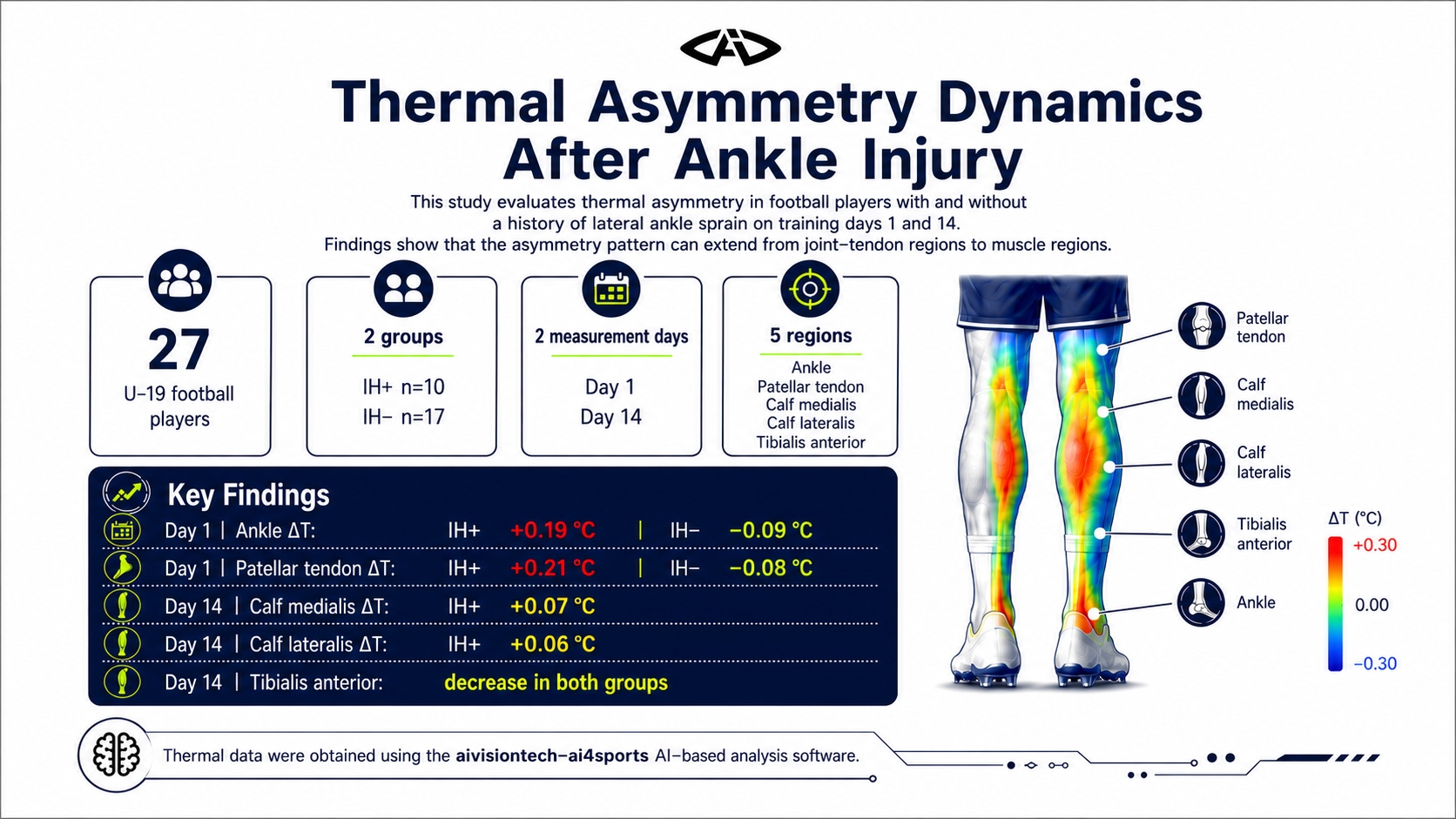
This blog summarizes a study that examined how thermal asymmetry changed on training days 1 and 14 in football players with and without a history of lateral ankle sprain. The findings suggest that, in previously injured players, the asymmetry pattern may extend from joint–tendon regions toward muscle regions under training load.
Overview
Lateral ankle sprain is one of the most common sports injuries, especially in sports that involve frequent running and jumping. This study focused on whether football players with a previous lateral ankle sprain history show a different thermal response to training load compared with players without such a history.
The main question was whether training-related thermal asymmetry remains limited to the ankle region or whether it spreads over time to nearby tendon and muscle structures.
Main takeaway: In football players with a history of lateral ankle sprain, training load was associated with thermal asymmetry patterns that were more pronounced and more widespread than in players without injury history.
Methodology
The study included 27 U-19 football players from a Turkish Süper Lig club. Players were divided into two groups based on injury history:
| Group | Definition | n |
|---|---|---|
| IH+ | Players with a previous ankle injury causing at least 3 days away from play | 10 |
| IH− | Players without ankle injury history | 17 |
Thermal images were collected at two time points:
- Day 1 of the training camp
- Day 14 of the training camp
For both days, images were taken:
- before training
- after training
The following 5 regions were analyzed:
- Ankle
- Patellar tendon
- Calf medialis
- Calf lateralis
- Tibialis anterior
Thermal data were obtained using the aivisiontech–ai4sports AI-based injury risk analysis software. A FLIR T540-EST thermal imaging device was used. For each region, the study calculated:
- Right–left temperature difference (ΔT)
- Training-provocation change (ΔPost–Pre)
Key Findings
Day 1 Findings
On the first training day, the most notable post-training increases in thermal asymmetry were seen in the injury-history group (IH+), especially in the ankle and patellar tendon regions.
| Region | IH+ Change | IH− Change |
|---|---|---|
| Ankle | +0.19 °C | −0.09 °C |
| Patellar tendon | +0.21 °C | −0.08 °C |
| Calf medialis | +0.01 °C | +0.01 °C |
| Calf lateralis | +0.06 °C | +0.03 °C |
| Tibialis anterior | +0.16 °C | +0.01 °C |
These results show that, on Day 1, the acute thermal response to training was more evident in players with previous ankle injury, particularly at the joint–tendon level.
Day 14 Findings
By Day 14, asymmetry in the injury-history group remained elevated from the pre-training stage onward, especially in the ankle and patellar tendon regions.
In addition, the asymmetry pattern became more visible in the calf muscles:
| Region | IH+ Change | IH− Change |
|---|---|---|
| Calf medialis | +0.07 °C | +0.00 °C |
| Calf lateralis | +0.06 °C | +0.00 °C |
For the ankle region:
- IH+: 0.39 °C before training and approximately 0.39–0.40 °C after training
- IH−: 0.25 °C before training and 0.19 °C after training
For the patellar tendon region:
- IH+: 0.37 °C before training and approximately 0.37 °C after training
- IH−: 0.21 °C before training and 0.28 °C after training
These findings suggest that the asymmetry observed acutely on Day 1 may persist and extend toward the muscle level by Day 14 in players with injury history.
Tibialis Anterior Pattern
The tibialis anterior region showed a different pattern from the other regions.
On Day 1:
- IH+: 0.16 → 0.32 °C
- IH−: 0.24 → 0.25 °C
On Day 14, both groups showed a decrease after training:
- IH+: 0.25 → 0.19 °C
- IH−: 0.26 → 0.18 °C
The study notes that there was no clear separation between groups in this region on Day 14.
Interpretation of the Results
According to the study, football players with a previous lateral ankle sprain history showed a distinct thermal asymmetry response to training load. On Day 1, the differences appeared mainly in the ankle and patellar tendon regions. By Day 14, this pattern had extended toward the calf muscles.
The authors interpret this as a possible sign of:
- altered neuromuscular control,
- compensatory load distribution,
- persistent effects of previous ankle injury.
The findings also support the idea that post-injury monitoring should not be limited only to the ankle. The knee-related region represented by the patellar tendon, as well as the lower-leg musculature, may also need attention.
Clinical note: The study suggests that follow-up after ankle injury may benefit from including the ankle, knee-related structures, and calf muscles together.
Limitations
The paper highlights several limitations of thermography:
- Environmental factors such as temperature, humidity, and airflow can affect measurements.
- Skin emissivity may differ across individuals and anatomical regions.
- Sweating and skin moisture may influence infrared emission and affect the interpretation of asymmetry values.
For this reason, the authors emphasize the importance of standardized protocols and careful interpretation.
Conclusion
This study shows that thermal asymmetry responses to training differ between football players with and without a history of lateral ankle sprain. In previously injured players, the asymmetry was more evident in the ankle and patellar tendon on Day 1, and by Day 14 it appeared to extend toward the calf muscles.
The findings indicate that AI-assisted infrared thermography may help identify subtle asymmetry patterns that are not always clinically obvious. In this context, thermal monitoring may support individualized load management, recovery follow-up, and post-injury prevention strategies.