



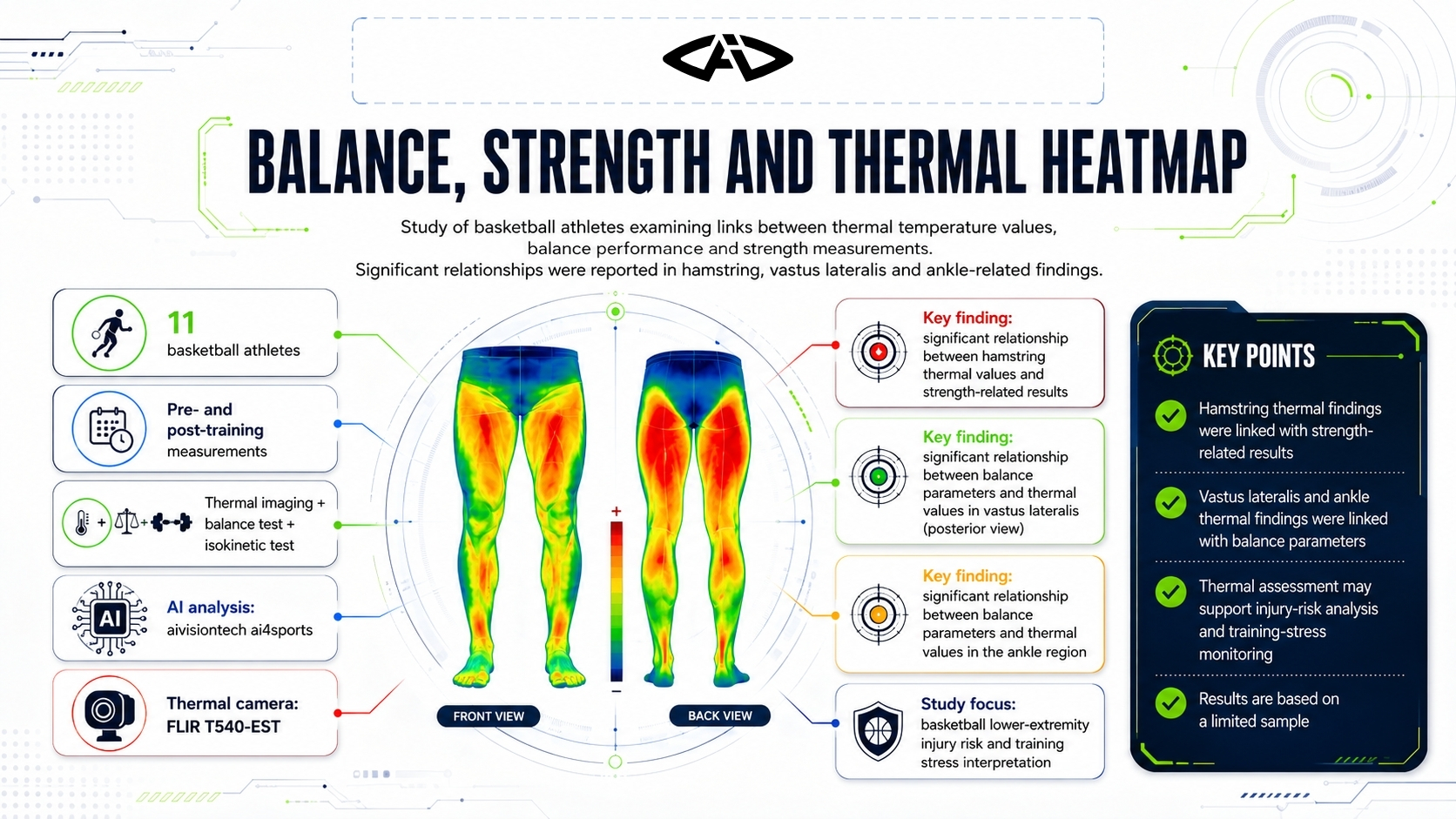
Lower-extremity thermal values, balance performance and isokinetic strength were evaluated within the same protocol in basketball athletes. The findings showed significant relationships between strength and hamstring thermal values, and between balance parameters and thermal values in the vastus lateralis and ankle regions.
Study Objective
Basketball is a high-intensity sport that simultaneously requires speed, coordination, balance, and aerobic and anaerobic capacity. The lower extremities carry much of this demand and are also a common site of injury.
This study statistically examined the relationships among:
- thermal temperature values,
- isokinetic strength results,
- dynamic balance measurements.
Key message: A thermal heatmap does more than display surface temperature; in selected muscle and joint regions, it may also reflect patterns related to strength and balance.
Participants and Dataset
The study included 11 basketball athletes. The dataset contained:
| Measurement | Scope |
|---|---|
| Thermal temperature | Mean and maximum temperatures of lower-extremity flexor and extensor muscles |
| Isokinetic testing | Measurements reflecting muscle strength |
| Balance testing | Overall, anterior-posterior and medial-lateral stability indices |
Data were collected before and after the testing procedure.
Measurement Procedure
Participants arrived at the laboratory in a rested state. The procedure followed this sequence:
1. Resting thermal imaging 2. Dynamic balance testing 3. Isokinetic knee-strength testing 4. Repeat thermal imaging after testing
The main interpretations were based on thermal images obtained after the isokinetic test, because this allowed thermographic assessment after muscle provocation.
Thermal Imaging
A FLIR T540-EST thermal camera was used. Lower-extremity images were captured:
- in a room with constant ambient temperature,
- from the front and back,
- at a distance of 2 metres.
All thermal assessments were performed with aivisiontech ai4sports software. The software extracted muscle regions from the thermal images and analysed their temperature values.
Isokinetic Strength Testing
The athletes completed a standard warm-up:
- 5 minutes of warm-up movements,
- 15 minutes of cycling at 30% resistance.
Knee flexion and extension strength were then measured at 90°/s and 180°/s. Peak and average power values were recorded for both legs.
Dynamic Balance Testing
Dynamic balance was measured using the Biodex Balance System. Athletes were tested on the dominant and non-dominant leg in a single-leg stance.
Three scores were obtained:
| Abbreviation | Definition |
|---|---|
| OSI | Overall Stability Index |
| APSI | Anterior-Posterior Stability Index |
| MLSI | Medial-Lateral Stability Index |
Key Findings
Hamstring Strength and Thermal Values
A significant Pearson correlation was found between the maximum isokinetic values of the right and left flexor muscles and maximum thermal temperature:
- r = 0.74
- p = 0.02
This result suggests that the hamstring group should receive particular attention in thermal assessment of basketball athletes.
Vastus Lateralis and Balance
Significant negative relationships were found between mean vastus lateralis temperature and balance-test results.
| Balance parameter | Spearman | p | Pearson | p |
|---|---|---|---|---|
| OSI | −0.80 | 0.009 | −0.66 | 0.05 |
| APSI | −0.75 | 0.01 | −0.71 | 0.03 |
The MLSI results approached but did not reach statistical significance.
Ankle and Balance
A significant Spearman correlation was found between mean ankle-region temperature and the Overall Stability Index:
- r = 0.73
- p = 0.02
Relationships with APSI and MLSI were not statistically significant.
Areas Without Significant Relationships
No significant relationships were found between:
- isokinetic flexor/extensor ratios and balance scores,
- extensor isokinetic ratios and extensor thermal ratios,
- many of the other muscle regions and balance parameters.
This indicates that the observed thermal relationships were concentrated in specific anatomical regions rather than distributed across all muscles.
Interpretation
The relationship between hamstring strength and thermal temperature suggests that basketball-specific loading may influence thermal patterns in this muscle group.
The relationships observed in the vastus lateralis and ankle regions indicate that thermal heatmaps may also reflect external stress and adaptive loading during balance tasks, not only strength output.
Clinical note: Thermal analysis may support combined assessment of the hamstrings, vastus lateralis and ankle regions when considering loading patterns and injury risk in basketball athletes.
Limitation
The study included only 11 athletes. The authors therefore stated that the findings should be confirmed in larger samples.
Conclusion
In basketball athletes, the thermal heatmap was influenced by both strength and balance parameters. Significant relationships were found between isokinetic strength and hamstring thermal values, and between balance measurements and thermal findings in the vastus lateralis and ankle regions.
These findings suggest that thermography may be useful as a supportive tool for evaluating injury mechanisms, injury risk and training stress.